
By Natasha Kabanda
Poaching and the illegal bushmeat trade have long been identified as among the greatest threats to wildlife in Zambia. Across the country’s forests, chiefdoms, and wildlife corridors, animal populations have been quietly hollowing out, not by natural causes but by sustained, demand-driven exploitation. Those involved in hunting are often community members driven by economic necessity rather than professional criminals. Community game farms seek to address this challenge by providing sustainable alternatives.
WCP Zambia’s This Is Not A Game campaign (TINAG) has been confronting this reality head-on. Through public engagement and community-level advocacy, TINAG has worked to challenge the normalisation of bushmeat consumption and shift attitudes among urban consumers who fuel the demand. The results have been encouraging: 60% of respondents in a post-campaign survey changed their views on bushmeat. But the campaign also surfaced a harder truth, 74% of consumers did not know where to find legal meat, and only one in three could confidently identify whether what they were buying was legally sourced. Changing minds was only part of the work. The other part was helping communities build the supply.
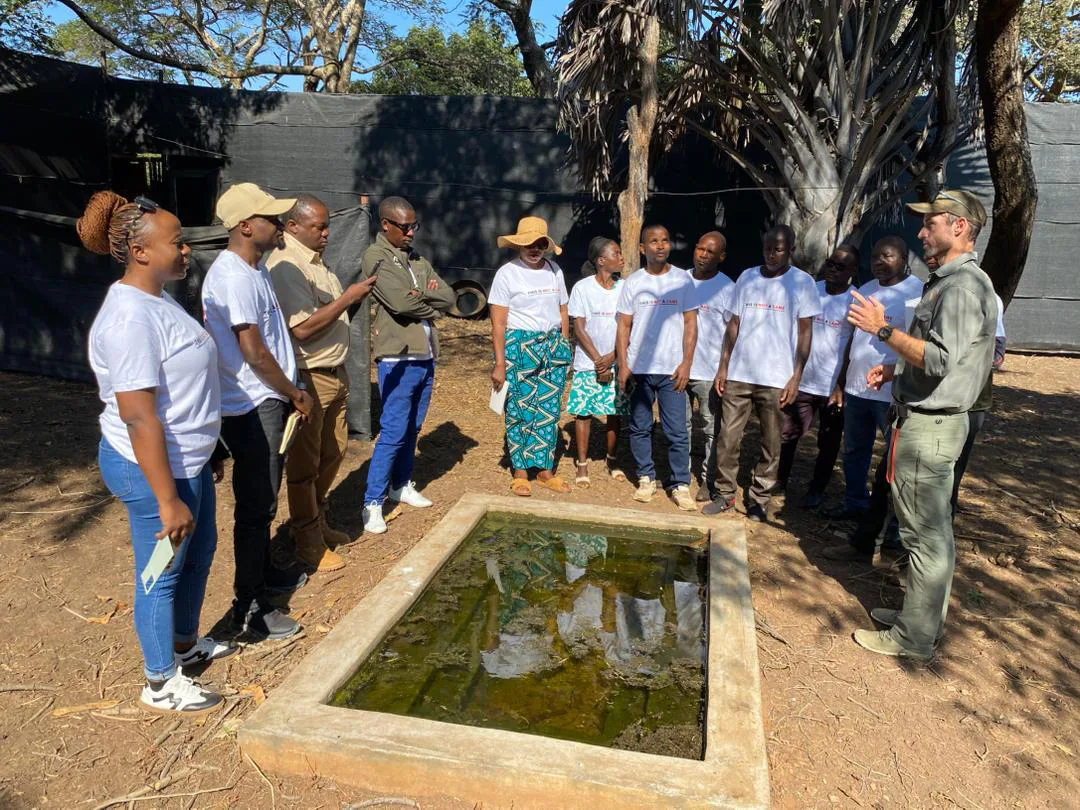
In Northern Province, that work found its footing in the Iyendwe valley in Chitimbwa Chiefdom, sitting in the eastern boundary of Nsumbu National Park. With high miombo woodland and dambos, reliable rainfall, and wild forage in abundance, Iyendwe has the natural conditions for a viable game farm. Alongside a rapidly recovering and well-managed national park with freely moving wildlife that can contribute to a natural recovery of key species, the opportunity in Iyendwe is clear. Through TINAG, WCP Zambia partnered with the Nsumbu Tanganyika Conservation Programme (NTCP) to support the Chitimbwa Iyendwe Conservation Project (CICP) in turning that potential into practice. In May 2026, NTCP facilitated an eight-day exposure visit across Muchinga, Central, and Southern provinces, taking the CICP team to four game farms to learn from operations that are already working, and exposure to different operational models.
Each farm offered something different. At Shiwa Ng’andu Farm in Muchinga, the team spent two days with a private operator who has built a diversified enterprise from the ground up, earning revenue through safari hunting, sustainable timber harvesting, and livestock, all running on the same land. The visit showed that wildlife and commercial farming are not in competition; managed well, they strengthen each other.
The team also witnessed a demonstration of how locally trained dogs can be used to track and detect poachers, an effective and low-cost approach that any community operation could adopt. To demonstrate his dedication to the success of community-led conservation, farm owner Charles Harvey presented the CICP group with ten bushbucks. This generous donation, which extended well beyond the technical expertise provided during the visit, is intended to help stock the team’s future game ranch and serves as a formal pledge of support for the growing sector of community game ranching.
In Mumbwa, Central Province, the team visited the Kaindu Community Game Ranch, a community-owned operation leased to a private conservancy for 25 years. The engagement with community governance structures, including the Community Resource Board and the Kaindu Natural Resources Trust, offered the CICP team an honest look at both the promise and the pitfalls of the model.
At Matobo Veterinary in Mazabuka, Dr. Neil Parsons, a seasoned veterinary doctor, walked the team through the health management demands of running a game ranch. He covered disease control, biosecurity, breeding management, and wildlife capture and translocation, areas that are often overlooked by communities in the early stages of planning but that determine whether an operation survives long-term.
Dr. Parsons emphasised, “Biosecurity is not a once-off exercise but a continuous management discipline, and that communities entering the game farming space need to treat animal health with the same seriousness as they treat fencing or revenue.”
The final farm, Kushiya in Southern Province, gave the team a practical grounding in game meat production and abattoir operations, from field harvest through to processing and compliance. Chaliafya Katungula Katangala, Programme Manager for the Wildlife Producers Association of Zambia (WPAZ), explained that wildlife in Zambia is managed under a national legal framework.
“This framework provides pathways for communities to play an active role in conservation while deriving economic and social benefits from wildlife resources,” Katangala said.
For the Chitimbwa Community, this opened an important conversation on the options available for establishing and managing wildlife populations on community land. Participants were encouraged to engage with the Department of National Parks and Wildlife (DNPW) to explore mechanisms such as wildlife quota allocations and other arrangements that could support community-led wildlife management. The discussion generated considerable interest, with community members expressing enthusiasm about the potential for wildlife-based enterprises to contribute to local livelihoods, conservation, and long-term rural development.
Community game farms, done right, are about far more than wildlife. They are economic engines. A well-managed operation can generate income through safari hunting, legal game meat for a market that is hungry for traceable, sustainably sourced protein. It can sustain timber enterprises on a rotational basis, support livelihood farming alongside wildlife, and enable photographic tourism, attracting visitors who pay to see animals alive and thriving.
Communities with access to water, as Iyendwe does, can layer in additional water-based enterprises. Honey production requires minimal capital and has a reliable demand. At a commercial scale, these enterprises do not just complement each other; they make the entire model resilient.
That resilience is what turns a conservation initiative into a lasting community institution. In areas where people have little to lose, poaching persists. Community game farms change that. When wildlife becomes a source of income, food, and collective pride, and protecting animals makes more economic sense than harming them, the argument for conservation makes itself. Zambia has the land, the wildlife, and the communities ready to make this work. Community game farms are not a future aspiration. They are the way forward, and the time to build them is now.
0 Comments