
By Salima Mvula
“Participation does not necessarily mean influence.” This was a key lesson that lingered in Chanda Mutuna’s mind from the recently ended Women for Conservation (W4C) Leadership Programme retreat. A distinction that changed the way she looked at the participation of women in natural resource management, and even at her own role as an emerging conservation leader.
For Chanda, one of the most important lessons from the retreat was not necessarily about learning something completely new. It was about learning to see familiar things in a new light.
As she sat through discussions on barriers, gender norms and power, one idea kept returning to her: being present does not necessarily mean having influence.
A woman can attend a community meeting, contribute to a discussion, serve on a committee or participate in a conservation programme and still have little say in the decisions that follow.
This realisation was especially relevant to her work in Mfuwe, Mambwe District, as Communications Manager at Conservation South Luangwa, where she has observed women actively participating in community meetings. Women who are often present in significant numbers speak up and contribute to discussions.
But following the retreat, Chanda found herself asking a different question. What happens after the meeting, once their insights have been shared and the discussion has ended?
Are women’s contributions reflected in decisions? Is their knowledge respected? Do they influence resources and outcomes?
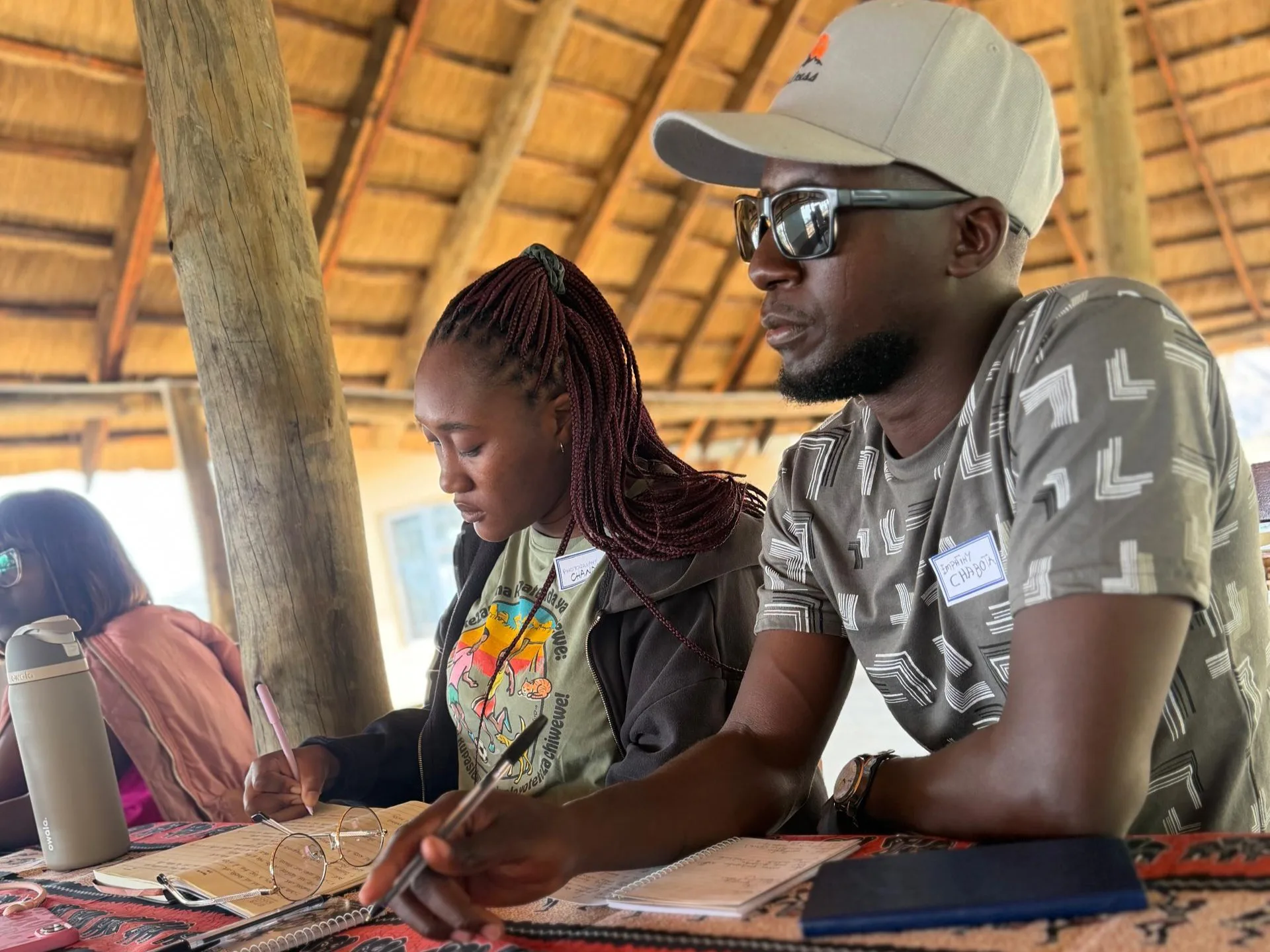
These questions emerged during the second Gender and Leadership Empowerment (GLE) session of the W4C Leadership Programme, which was facilitated by Lawyer and Gender Specialist Kafula Kamiji, held from 2 to 4 September 2026 at Mwamfushi Safari Lodge in Kafue National Park.
The retreat brought together 10 emerging conservation leaders for two days of learning, reflection and connection, under the theme “Barriers and Power”, which explored some of the less visible ways gender norms and power dynamics can shape women’s participation and leadership in conservation.
Kamiji described the training as an opportunity to help the leaders understand the social and institutional factors that influence women’s participation and leadership.
“It equips leaders with the confidence and tools to recognise and challenge these barriers and create more inclusive spaces within conservation,” she said.
She further explained that these barriers include: gender stereotypes, unequal access to leadership and decision-making spaces, limited access to resources, and cultural norms that may discourage women from taking leadership roles.
But it was not simply a classroom exercise. Away from their usual workplaces and daily responsibilities, the early-career conservationists had the opportunity to sit together, share experiences, and begin to know one another beyond their professional roles. For a group embarking on a year-long leadership journey together, this opportunity to bond mattered.
Before attending the retreat, Chanda noted understanding barriers and power as the social, cultural, and practical factors that can limit women’s access to opportunities. However, through the training, she learnt to see how interconnected those barriers can be, and how differently they can appear depending on the community and context.
One discussion that stayed with her was around women’s access to and control over land.
She had previously understood land as an important resource but had not considered deeply enough how the distinction between access and control could affect women. Stating that a woman may be allowed to use a piece of land, for example, without having the authority to make decisions about it.
This was a discussion during the training that also prompted Chanda to reflect on her own experiences in Mfuwe, a context she describes as matrilineal.
She explained how actively women participate in community meetings, which served as a reminder that assumptions about women’s participation cannot simply be applied everywhere.
“Gender roles are socially shaped, vary between communities and can change over time,” she said.
It is a lesson that may sound simple, but in conservation, where programmes often work across different communities and landscapes, understanding context can make the difference between simply involving people and creating meaningful opportunities for them to influence decisions.
The retreat, therefore, challenged participants to look beyond numbers and visibility and consider the quality of participation.
Beyond the discussion on barriers, which encouraged Chanda to look outward, the conversation on power also encouraged her to look inward.
The training explored different forms of power, including “Power Within”, “Power To”, and “Power With”. These concepts helped participants think about power not only as authority or seniority, but also as confidence, skills, relationships, knowledge and the ability to act.
Chanda noted that “Power Within” struck a particular chord. Adding that her understanding of self-confidence, self-worth and self-awareness had always been important qualities. But bringing them together under the idea of power gave them a different meaning.
She began to recognise that believing in the value of her own voice is itself a form of power.
That was especially significant because Chanda works in Communications, a role that does not necessarily place her at the centre of field interventions, but one that can influence how conservation work is understood.
Through communications, she helps determine which stories are told, whose contributions are made visible and how conservation issues reach different audiences.
“Communication has influence,” she said. And the retreat helped her recognise that influence as part of her leadership. Noting that with influence comes responsibility.
The term leadership is no longer simply about gaining more power or waiting for a senior position for Chanda. It is also about using whatever influence one already has to create space for others.
Chanda plans to apply what she has learned through her work in communications by being more intentional about whose voices and perspectives are represented in conservation stories.
She wants to ask who is being heard, who is missing, and whose knowledge is being recognised. Rather than simply showing that women participate, she hopes to highlight their knowledge, expertise, leadership and agency.
That is perhaps where Chanda’s own understanding of leadership has come full circle.
The retreat did not suddenly make her a leader. It helped her recognise the leadership that was already present in the work she was doing.
“It is easy to associate leadership with reaching a particular position or having a certain title,” she says.
But leadership can also be expressed through initiative, influence, collaboration and the ability to create opportunities for others.
Her message to young women in conservation is simple, “Do not let the barriers around you determine how you see yourself or the value of what you have to contribute.”
Some barriers may take time to change, but recognising your own knowledge, abilities and worth is a form of power. Finding mentors, colleagues, women and allies who can offer support and encouragement can also make the journey easier.
The idea of “Power With” reminds Chanda that leadership does not have to be a solitary journey.
Chanda believes that true leadership means using one’s influence not only to take up space, but to make it easier for another woman to take up hers.
While the discussions focused on understanding barriers, gender norms, and power, the retreat also offered something that cannot easily be captured in a training agenda: time for the participants to connect as people.
The 10 leaders under the programme are at different stages of their conservation journeys and work in different areas, but the retreat gave them space to exchange experiences, learn from one another, and build relationships. This was encouraged through an experience in Kafue National Park together, including a night game drive and a boat cruise on the Kafue River.
These moments provided a different kind of learning, one rooted not in presentations or exercises, but in conversation.
As the 10 W4C leaders continue their year-long journey, they are carrying not only new knowledge about gender-responsive leadership, but also the connections and relationships they have built along the way.
0 Comments