
By Natasha Kabanda
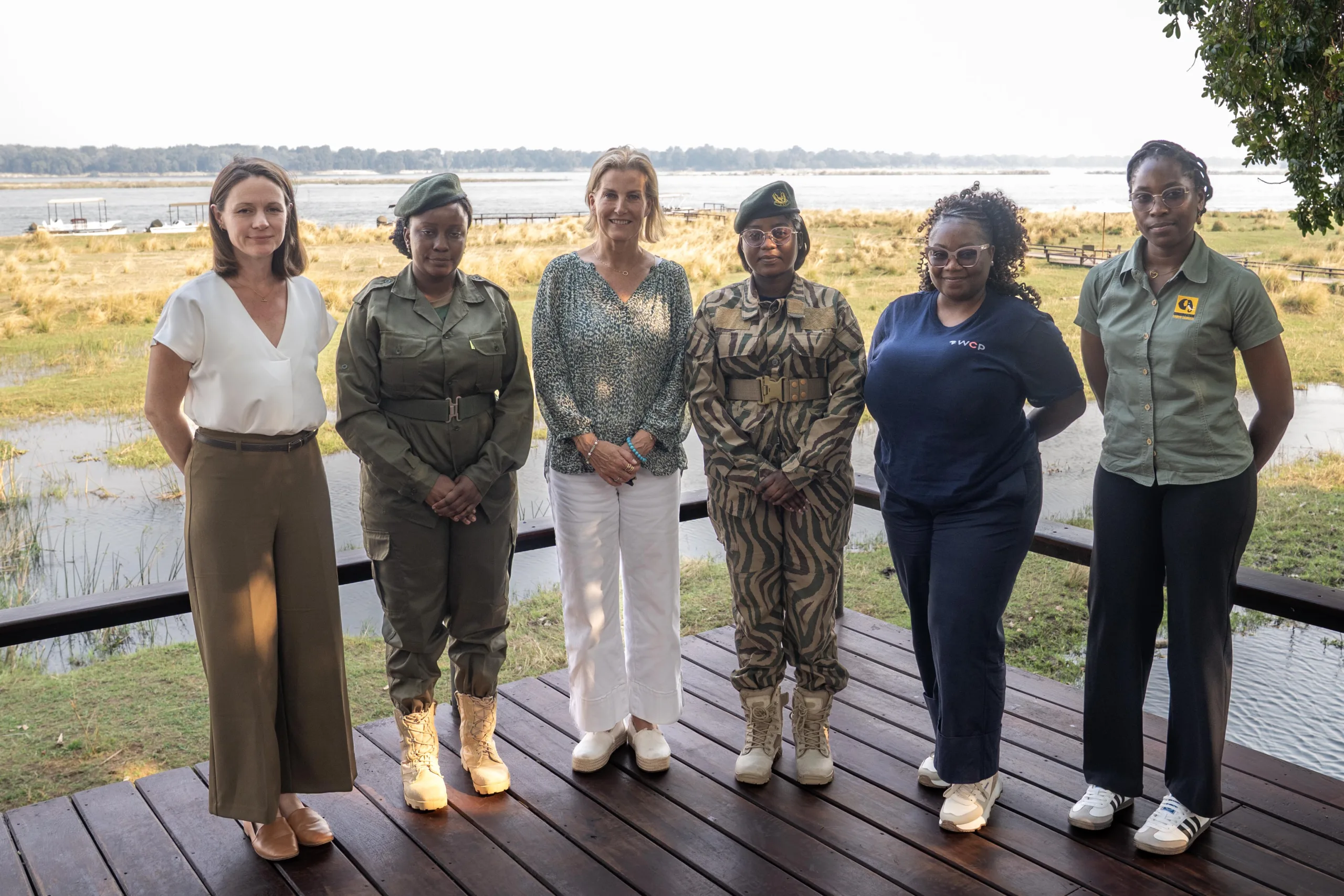
During her visit to Zambia last week, Her Royal Highness the Duchess of Edinburgh met Wildlife Crime Prevention Zambia (WCP) as part of her engagement with organisations advancing women’s enterprise and conservation. At a roundtable discussion in Lower Zambezi, with women in conservation and wildlife law enforcement, the Duchess listened attentively and probed their experiences.
The roundtable brought women with frontline experience of wildlife protection and organisational change. Participants included WCP’s Chief Executive Officer Sarah Davies and Communications Officer Maina Malaya, Hope Ngulube, a Department of National Parks and Wildlife (DNPW) Police Officer; Margaret Chiawa, a Community Scout with Conservation Lower Zambezi’s (CLZ) Kufadza Team; and Treaser Nyirenda, CLZ Gender Champion and Assistant Data Management Officer.
A Zambian national assessment in 2020 found that men led 72 of the country’s 76 Community Resource Boards, while women represented just three of 38 scouts in Chikwa and three of 57 in Chifunda. Restrictive gender norms, unequal selection processes and limited institutional support continue to restrict women’s employment and leadership opportunities. The numbers tell part of the story. The women at the roundtable gave those numbers a human face.
“We were not too many when I joined conservation in 2024, we were about 4 women only, but now we are 10 women. Our numbers are increasing, with me being a community scout more, especially being a lady in the Kufadza team, I would like to lead by example to my fellow ladies,” Margaret commented during the discussion
Recruiting women is an important step, but it does not automatically create an inclusive workplace. Women can pass the same demanding selection processes and perform the same difficult duties as men yet still work in environments designed almost entirely around male employees.
When asked during the roundtable what she is learning about the barriers women continue to face and the changes most likely to work, Maina explained:
“We are learning that recruitment is only the beginning. Women still face unsuitable facilities, limited equipment, family-care pressures, harassment and fewer leadership opportunities. Supportive managers, safe reporting systems, proper equipment, mentoring and clear promotion pathways could make the greatest difference.”
These are practical concerns that most conservation organisations have noted and have begun working towards. A woman deployed to a remote camp needs suitable accommodation, sanitation facilities, protective equipment and uniforms that fit. She needs confidence that harassment can be reported safely and handled fairly. She also needs access to training, challenging assignments, mentorship and transparent promotion opportunities. If these conditions are absent, organisations may successfully recruit women but struggle to retain them or support their advancement into leadership.
Conservation Lower Zambezi offers an important example of progress made in recruitment and onboarding. In 2021, CLZ established Kufadza, Zambia’s first all-female community scout unit. Its members have since undertaken frontline duties and moved into specialised functions, challenging assumptions about women’s suitability for wildlife law enforcement. One such woman is Hope, who shared what it takes to be a Ranger;
“Being a ranger doesn’t just require you to be physically fit, but it also needs you to be mentally stable ,to have endurance , courage and, most importantly, passion for this job”
She later shared how she plans to further her education to strengthen her work and pave the way for other women following in her footsteps
CLZ’s participation in the roundtable was especially relevant because it was one of five Zambian field sites included in WCP’s Conservation Synergies ranger gender equality and social inclusion project. WCP conducted interviews at CLZ and four conservation organisations, speaking with rangers and other personnel about recruitment, operations, infrastructure, training, wellbeing, promotion, leadership, integrity and accountability.
The wider project, Inside-out: Building a Framework for ranger GESI, is funded by the UK Government through the Darwin Initiative and delivered by WCP in partnership with Conservation Synergies, protected-area managers and site-based Gender Equality and Social Inclusion Champions. It works across ten protected areas in Zambia, Mozambique, Malawi and South Africa.
Conservation organisations operate in different environments, with different resources, structures and challenges. The project is gathering locally grounded evidence that can help managers identify barriers, select realistic interventions and measure whether conditions are improving.
There are encouraging signs of progress across the sector. Zambia commissioned 177 new Wildlife Police Officers in June 2025, the country’s largest such graduation in two decades, demonstrating renewed investment in frontline wildlife protection. The next challenge is ensuring that recruitment and training opportunities translate into stronger gender representation, supportive workplaces and fair career progression.
The roundtable showed why women must be part of that conversation. The Duchess and her team’s questions gave participants space to move beyond ceremonial messages and discuss what inclusion looks like in daily working life. Their experiences demonstrated that women are not asking for lowered professional standards. They are asking for the equipment, systems, leadership and opportunities required to meet those standards and build lasting careers.
Zambia’s wildlife faces complex pressures, including poaching, illegal resource extraction, habitat loss and human-wildlife conflict. Responding effectively requires the strongest possible workforce. The country cannot afford to overlook the talent, experience and leadership of half its population.
0 Comments