
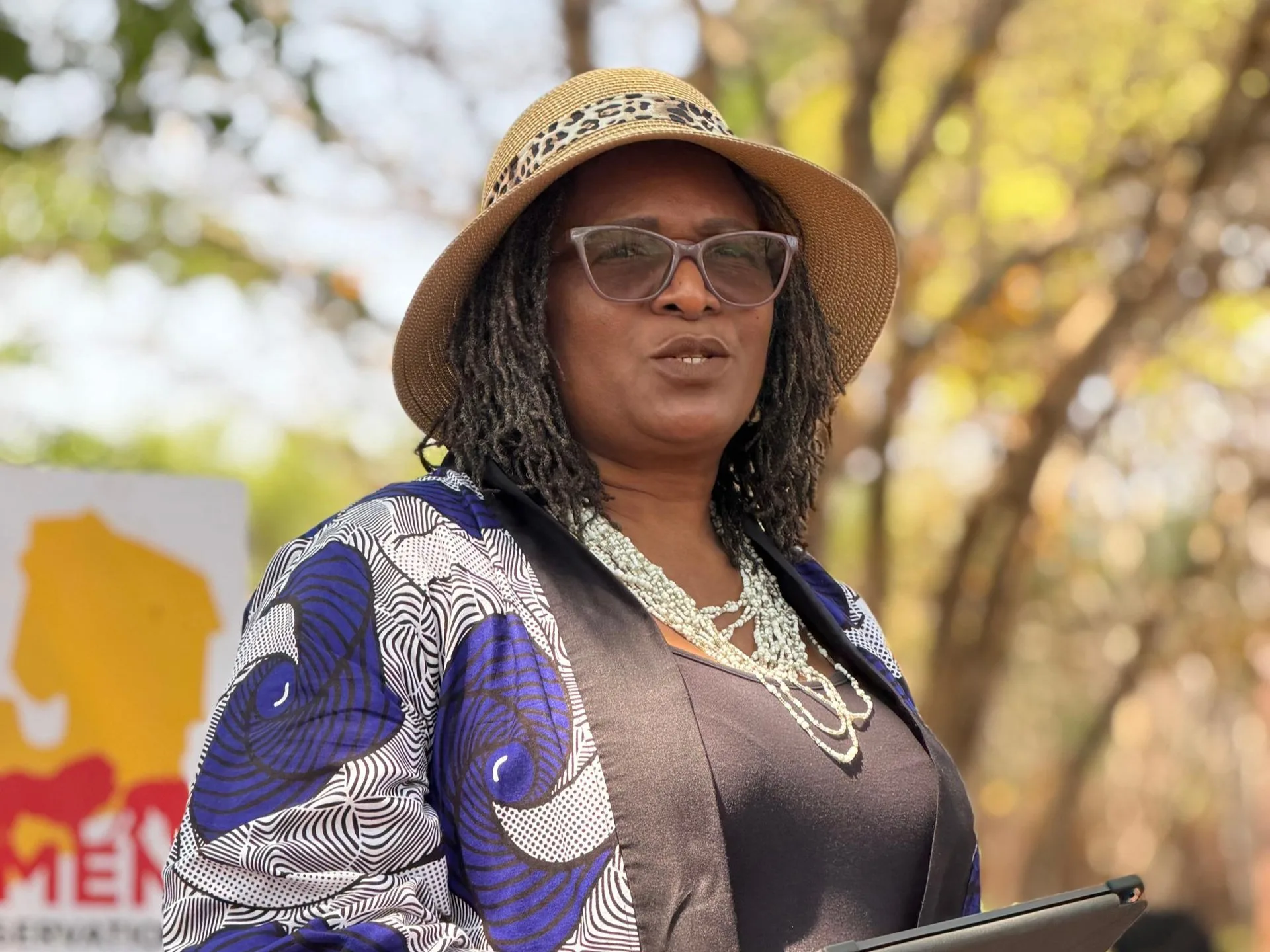
By Salima Mvula
From learning conservation at her grandparents’ homestead to helping shape climate policy, Carol Mwape Zulu’s journey demonstrates the power of purpose, perseverance, and investing in the next generation of environmental leaders.
“Stay rooted in your values. Be driven by purpose.”
These words, shared by Carol Mwape Zulu during her talk at a recent Women for Conservation (W4C) networking event, Bush, Sip and Talk, reflect the philosophy that has guided her through more than three decades in conservation and environmental management.
Her journey began not in a university lecture hall or government office, but at her grandparents’ homestead in Mukamba Village, in Mwansabombwe District of Luapula Province. Raised by grandparents she describes as self-taught conservationists, Carol learnt early that protecting the environment starts with everyday choices.
“I grew up practising conservation at a tender age, helping my grandfather supervise firebreaks and early burning. My grandmother would make charcoal, just enough for our consumption, using branches of fast-growing trees around the house, while leaving the other trees to grow wide and tall to reduce the strength of winds and protect the roof,” she recalled.
These experiences laid the foundation for a career that would take her from forest management to international climate policy. However, her decision to pursue forestry was not immediately welcomed by her father, who had hoped she would become a lawyer after performing well in her Grade 12 examinations.
When Carol enrolled at the Zambia Forestry College in Kitwe in 1991, her father worried she was wasting her potential on a profession he associated with ba Kapenda Mabula, a local Zambian term which refers to forestry guards and rangers “counting leaves”, who patrolled forest reserves. Carol, however, chose to follow her interest, joining a class of just five women among 17 students.
Her early work managing a seed bank for forest reserves helped her understand that conservation extended beyond protecting trees. Healthy forests also supported food production, employment, and community livelihoods.
This understanding deepened while she worked on the Provincial Forestry Action Plan with the Government of Finland. Through community engagement, she helped advance forest zoning and initiatives that enabled communities to participate in managing natural resources. Efforts included registering community trusts and appointing honorary forest officers, helping strengthen communities’ roles in forest management.
Carol explained that these experiences reinforced the importance of connecting lessons from the field with decisions made at policy level.
“What we do on the ground and the lessons we learn should find a way to get to policy formulation,” she emphasised.
Her career also taught her that technical experience alone does not always guarantee professional advancement. Despite years of experience in donor-funded projects, she spent more than five years in an entry-level position after returning to government service. The late Dr Nkhowani, her then director, encouraged her to pursue a master’s degree to improve her career prospects.
The experience shaped her approach to leadership. Today, she deliberately shares educational and career opportunities with colleagues, recognising that leadership involves creating opportunities for others to grow.
Around 2010, Carol began leading climate finance negotiations on behalf of the Least Developed Countries and later joined the committee tasked with designing the Green Climate Fund. Working alongside senior diplomats and finance experts in a male-dominated environment, she struggled with self-doubt but gradually learnt to trust her expertise and speak confidently on issues she understood.
Her experience showed that confidence does not always come before a challenge; sometimes, it develops by taking it on.
In 2018, Carol became Zambia’s first female Chief Climate Change Officer, leaving a World Bank-funded project to help establish the country’s first climate change unit. Despite the personal sacrifices involved, she saw an opportunity to strengthen partnerships, mobilise support and mentor her team. Her work contributed to initiatives including SPAR6C and FACE-NDC, alongside efforts towards the Green Economy and Climate Change Act.
Today, as Programme Specialist and Head of the Energy and Environment Unit at the United Nations Development Programme (UNDP) in Zambia, Carol continues to work with government, communities and development partners on climate resilience and environmental sustainability.
Yet she cautions against measuring success solely through titles or promotions. Career progression can be slow and unrewarding, she noted, making it important to remain focused on one’s purpose. She encourages young people, including women, to recognise their strengths, whether in public speaking, networking, partnership building or technical expertise, and use them to make meaningful contributions.
She also advises aspiring leaders to observe how their role models handle difficult conversations and challenging situations, while developing the ability to listen and learn.
These lessons were central to Carol’s talk at the W4C Bush, Sip & Talk networking event held at Chifwema Arboretum on 26 September 2026. Organised under the Women for Conservation movement, the event brought together 60 conservation professionals, enthusiasts and emerging practitioners to connect and exchange experiences.
Through the support of the Women and Girls Fund, W4C is providing women and gender-equality supporters in conservation with opportunities to build professional relationships, share knowledge and access mentorship and career development opportunities. Carol shared that speaking at the event was a chance to show that professional achievement is rarely an overnight accomplishment.
“I wanted others to know that my present position as UNDP Programme Specialist and Head of Energy and Environment did not just instantly happen,” she explained in a follow-up interview.
“It has been a journey that started with being groomed in conservation before I sat in a classroom to learn about protecting the environment. It has come with sacrifices, and it has demanded patience.”
She sees the Women for Conservation network as a valuable link between experienced professionals and emerging conservationists, helping young people explore opportunities ranging from research and communications to policy and climate finance. Through mentorship, networking, internships and volunteering, she believes the programme can help the next generation find its place in the sector.
“As women, we are not just participants in conservation. We are leaders and innovators. When women succeed, we can create many more opportunities for others,” she said.
For Carol, leadership is ultimately about more than personal advancement. It is about contributing meaningfully, sharing knowledge, and creating opportunities for others to succeed. Her message to emerging conservationists remains clear: stay rooted in your values, be driven by purpose, and make room for others to grow.
0 Comments