
By Salima Mvula and Maina Malaya
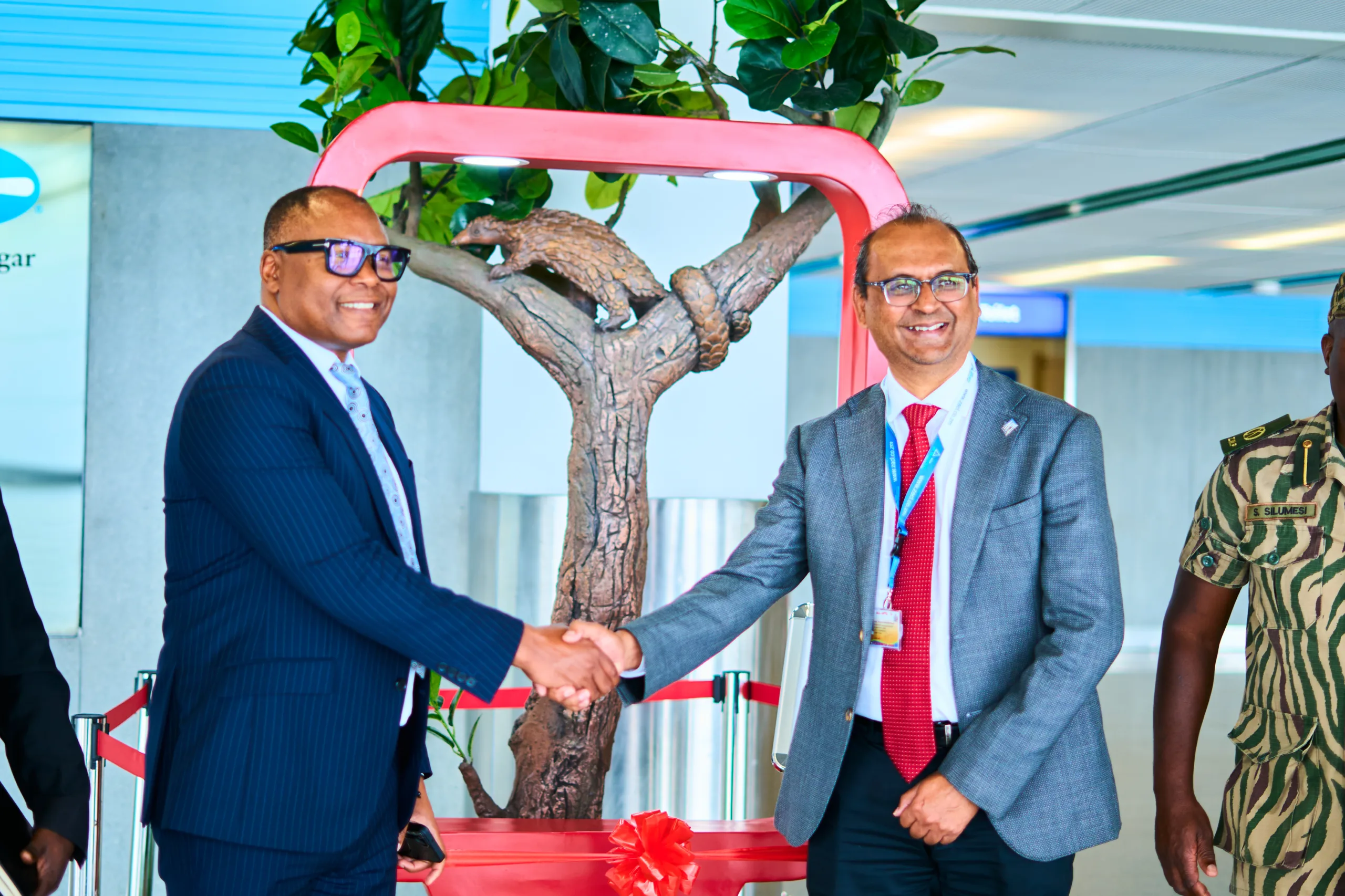
A new wildlife sculpture has been unveiled at Kenneth Kaunda International Airport, marking the fourth installation under the “Worth More Alive” campaign.
The life-size piece, which features two pangolin species found in Zambia, the tree pangolin and the ground pangolin, aims to raise awareness about the illegal wildlife trade, particularly among travellers passing through the country’s main international airport.
The unveiling was led by Wildlife Crime Prevention (WCP) Zambia in partnership with the Ministry of Tourism and the Zambia Airports Corporation Limited (ZACL), with attendance from government officials, conservation partners, and airport leadership.
Speaking at the event, WCP Communications Programme Manager, Mirriam Nasilele, reflected on the journey of the ‘Worth More Alive’ campaign. She noted that the initiative was created to address the need to enhance awareness and comprehension of wildlife crime, reducing the tolerance for it, and equipping air travellers with the tools to report any incidents or suspicions.
She highlighted that the illegal wildlife trade is a global challenge, generating billions of dollars annually and impacting thousands of species, including pangolins, elephants, and rhinos.
In Zambia, wildlife crime poses risks to biodiversity and the tourism sector, which remains an important contributor to the national economy. Airports have increasingly been identified as key points in the movement of trafficked wildlife and their products, both globally and locally.
“Between 2009 and 2019, airports worldwide recorded 2,008 wildlife seizures, totalling a surprising 75,000 kg of products and 5.5 million live animals,” Mirriam noted. “And here in Zambia, the reality is just as clear. The scale of the problem is evident in notable incidents from the 2017 seizure of 20 kg of rhino horn at KKIA, to the 2022 case of 15 live turtles disguised as fruit, and more recently, the 2024 conviction of traffickers fined K600,000 for smuggling wildlife.”
The “Worth More Alive” campaign, launched in August 2022 in collaboration with the Department of National Parks and Wildlife (DNPW) and ZACL, uses visual installations and educational materials to engage travellers at Zambia’s four international airports. These include Kenneth Kaunda International Airport, Simon Mwansa Kapwepwe International Airport, Harry Mwaanga Nkumbula International Airport, and Mfuwe Airport.
Alongside the sculptures, the campaign features over 130 multilingual posters and a 24-hour wildlife crime reporting hotline operated by DNPW officers.
A 2025 evaluation revealed the campaign’s success in boosting traveller awareness. Specifically, exposure to the campaign materials led to a 330% increase in traveller recognition of endangered species, such as the pangolin, one of the world’s most trafficked mammals.
Speaking at the unveiling, Ministry of Tourism Permanent Secretary Evans Muhanga said the installation reinforces Zambia’s commitment to addressing wildlife crime and encouraging public awareness.
“Zambia will not be a safe haven for wildlife crime. By placing these sculptures here, we are reminding every traveller that wildlife crime has real consequences and that each of us has a role to play in protecting these species,” he stated.
ZACL Managing Director Urvesh J. Desai added that airports can play an important role in supporting conservation efforts by providing a platform to reach large and diverse audiences.
“By integrating anti-trafficking messaging into our airport, we are making wildlife protection part of every passenger’s experience. Airports are becoming the frontline in combating this crime, spaces of vigilance, education, and responsibility,” he said.
The pangolin sculpture is now part of the airport environment and is expected to be seen by individuals travelling through Kenneth Kaunda International Airport.
The growing campaign continues to provide the public with an important reminder to remain alert and report any suspected wildlife crime through the DNPW hotline available at all four international airports, because Zambia’s wildlife is ‘Worth More Alive’.
0 Comments