
By Salima Mvula
This past weekend, Zambia joined the world in commemorating ‘World Pangolin Day’ under the theme set by the International Union for Conservation of Nature (IUCN): “Pangolin Guardians in Action.”
It is a call that resonates deeply in Zambia, where guardianship is not an abstract idea but a daily commitment carried by communities, law enforcement officers, educators, and conservation practitioners who work quietly and tirelessly to protect one of the world’s most trafficked mammals, pangolins.
But what does it truly take to be a guardian of a shy, nocturnal animal that many people may never see in the wild?
Is it advocacy? Storytelling? Reporting suspicious activities? Challenging myths? Supporting law enforcement?
The answer is all of the above.
In Zambia, guardianship begins with understanding that pangolins are more than scales and statistics. They are ecological engineers. By controlling ants and termites, they protect crops, safeguard homes, and help maintain soil health. Their survival is directly tied to food security, environmental stability, and community wellbeing.
As Mirriam Nasilele, Communications Programme Manager at Wildlife Crime Prevention (WCP), explains, “Being a Pangolin Guardian is not just about loving wildlife. It means being their voice and standing against the pressures that threaten their survival. Protecting pangolins is directly linked to protecting our wellbeing and the ecosystem services we depend on.”
Since 2019, WCP Zambia has worked closely with the Department of National Parks and Wildlife to combat the illegal pangolin trade. This collaboration has contributed to the seizure of over 800 pangolins, intercepted from trafficking networks.
Unlike many other trafficked species, pangolins are often more valuable to traffickers alive. This grim reality, however, has created a critical window of hope. Many seized pangolins are recovered alive, offering them a second chance.
Recognising the need for specialised care, WCP, in partnership with the Department of National Parks and Wildlife, established a dedicated pangolin rehabilitation centre. Here, rescued animals receive medical treatment, nutritional support, and species-specific care designed to restore their strength and prepare them for eventual release back into the wild.
Behind every successful release is a team of veterinary professionals, wildlife officers, caregivers, and programme staff, quiet guardians ensuring that each rescued pangolin has the best possible chance of survival.
But protection does not end at rehabilitation.
While some guardians work in rehabilitation centres, others work in classrooms.
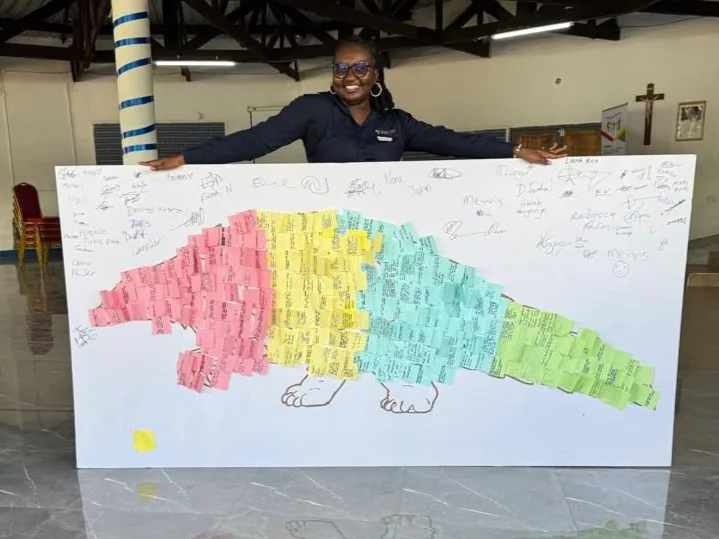
WCP’s Communications Team has emerged as a powerful internal force in pangolin protection. Through its Conservation Careers Fair initiative and broader community engagement efforts, the team facilitates school talks, community dialogues, and awareness sessions designed to demystify pangolins and reduce demand.
In 2023, WCP commenced formative research to guide its Pangolin Demand Reduction Campaign, a targeted initiative addressing misinformation, belief-based practices, and the myths that fuel illegal trade.
According to Maina Malaya, Communications Officer and lead on the Protect the Pangolin Awareness Campaign, misinformation is one of the biggest threats to pangolins. She explains, “In some communities, pangolins have been mystified and even mistaken for ‘lilombas’ — mythical creatures in Zambian folklore believed to have a human face and a snake-like body,” she explains. “These misconceptions fuel fear, secrecy, and harmful practices. By actively sharing accurate, science-based information, we can demystify pangolins, reduce stigma, and ultimately decrease demand.”
Through community engagement, WCP emphasises practical actions anyone can take, such as reporting suspicious wildlife crime sightings, leaving pangolins in the wild where they belong, refusing to buy wildlife-derived products, and challenging myths by sharing factual information. Small, consistent choices, made collectively, that create lasting impact.
Recently, WCP took part in the Association of International Schools in Africa – Global Issues Service Summit (AISA-GISS), hosted by the American International School of Lusaka. Under the summit’s theme, “Your Story, Your Voice,” students explored global challenges and collaborated on solutions.
WCP introduced participants to the reality that pangolins are the most trafficked mammals in the world, sharing insights from the Protect the Pangolin Programme and the newly launched demand reduction campaign.
What followed was a powerful reminder of what guardianship looks like in action.
Students visited the Bauleni Special Needs Project, where they shared what they had learned through peer-to-peer exchanges. In their own voices, they corrected myths, explained ecological roles, and encouraged stewardship.
This engagement showed that when young people find their voice and use it with purpose, conservation moves from theory to action.
Both Nasilele and Malaya emphasise that pangolin protection is not the responsibility of a single institution.
Traditional leaders hold cultural authority that can reshape harmful norms. Law enforcement ensures accountability. Researchers generate knowledge. Educators and communicators influence attitudes. Communities are often the first to witness illegal activities and can disrupt trafficking through timely reporting.
“Pangolin protection is not just law,” Malaya says. “It is a shared community responsibility.”
Coordination, respect for indigenous knowledge systems, and inclusive partnerships are essential. Zambia’s communities have long understood environmental signals and sustainable living practices. Conservation must build upon this lived experience.
World Pangolin Day is not only about celebrating a species. It is about confronting a crisis and choosing action.
If ecosystems are disrupted, the consequences are felt in crop losses from armyworm outbreaks, termite damage to homes, and declining soil health. Protecting pangolins contributes to maintaining the natural balance.
If we fail to act, we risk a future where the next generation will never see a pangolin in the wild.
But there is hope.
Across Zambia, Pangolin Guardians are already in action in rehabilitation centres, classrooms, communities, law enforcement units, and storytelling platforms. They are researchers, caregivers, students, cultural leaders, communicators, and ordinary citizens making deliberate choices.
This World Pangolin Day, the message is clear: guardianship is not reserved for a few. It belongs to all of us.
Because protecting pangolins today is not simply about saving a species, but also an investment in a stable, healthy, and resilient future for Zambia and beyond.
You can play your part as a Pangolin Guardian by supporting their protection. Consider making a contribution to help sustain the DNPW–WCP Rehabilitation Centre and its vital work rescuing, rehabilitating, and releasing pangolins back into the wild. To donate, please visit: www.wildlifecrimeprevention.com/Donate/
0 Comments